ENTRAINE®™ process envelops brainwave activity, strategically guiding it toward transformative states of consciousness.
ENTRAINE®™ AI Assisted Neural Entrainment Technology influences neurological activity through a multi-layered approach that combines numerous brainwave entrainment strategies with breakthroughs in psychology.
ENTRAINE®™ algorhitms significantly improve the efficiency of BrainWave Entrainment by seamlessly integrating multiple entrainment methodologies into a synergistic and powerful audio-visual matrices, thereby captivating more of the brain’s dynamic flows to produce synchronous brainwaves and deep states of meditation.
This results in a profoundly blissful and transformative experience.
*PATENT APPLICATION PENDING
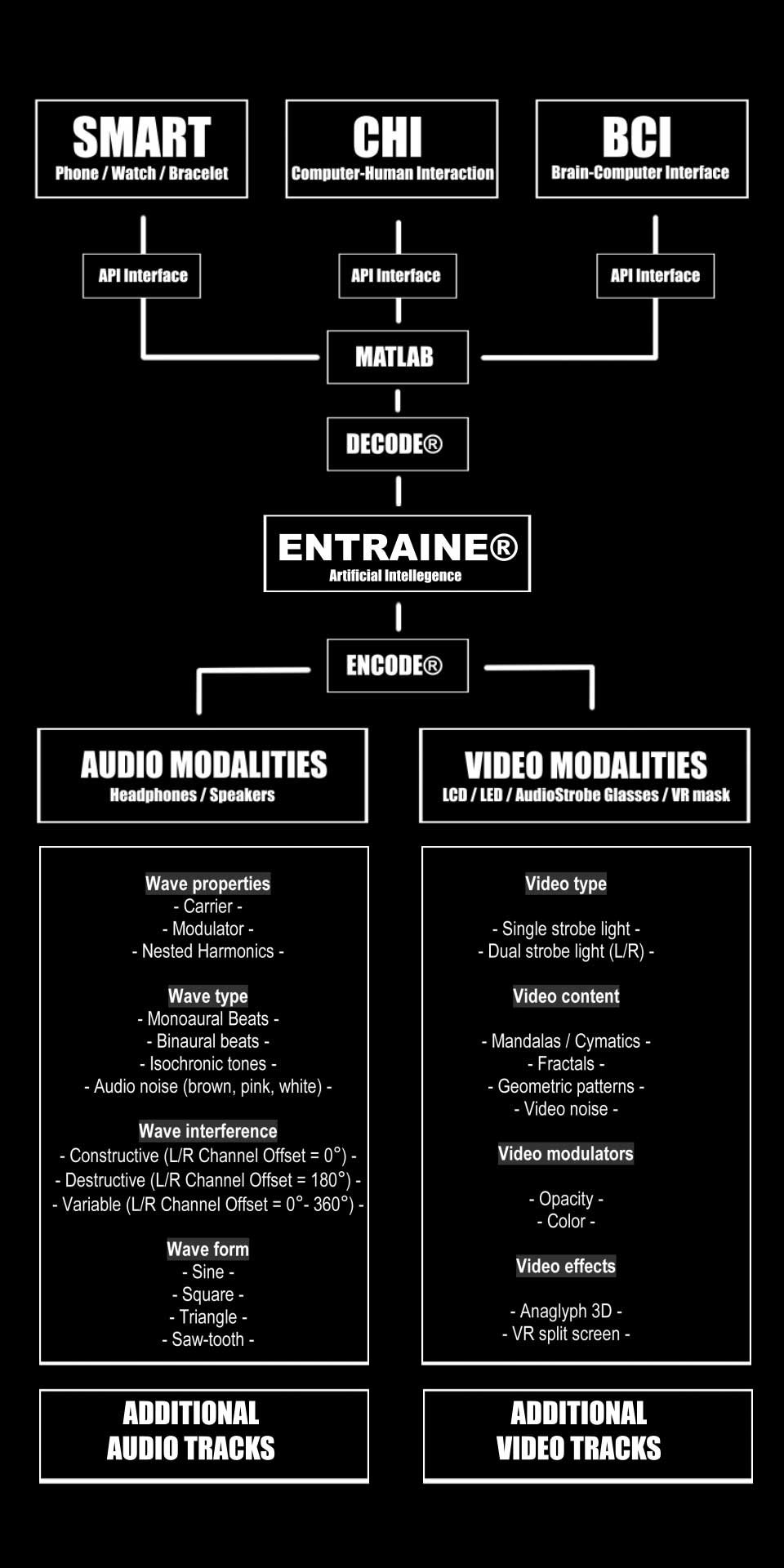
ENTRAINE®™ can be paired, integrated and used together with SMART / C-H-I / B-C-I Technology to provide real-time optimization of the IRP (Individual Rehabilitation Protocol).
ENTRAINE®™ compiles the mathematical algorithms for audio and video transducers using the data from the SMART / C-H-I / B-C-I Technology as INPUT VARIABLES.
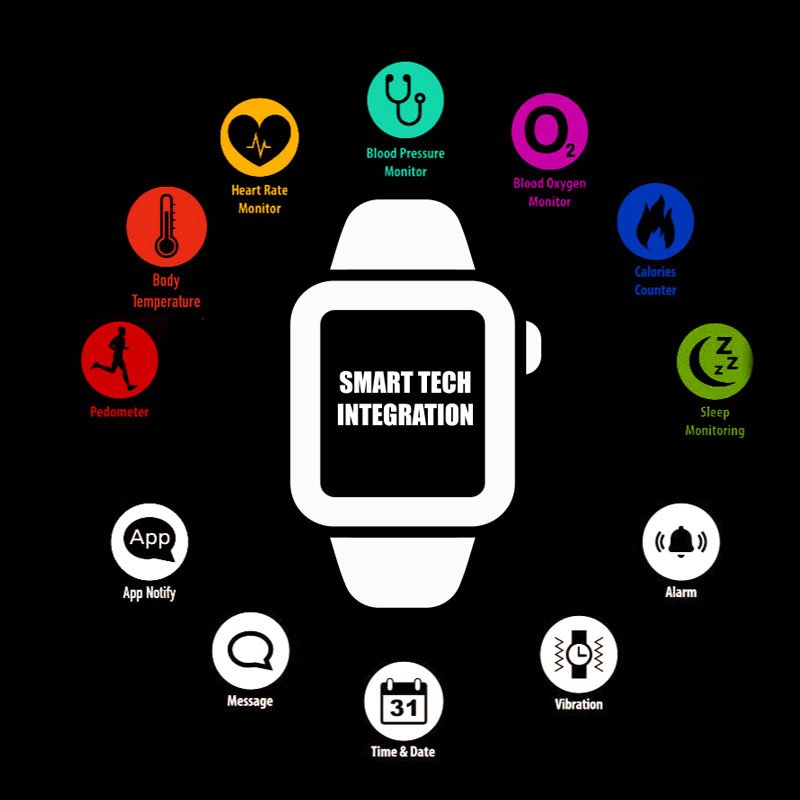
Recent advances in mechatronics, Internet of Things, wearable devices, and the miniaturization of sensors and electronics have significantly increased the capabilities of smart sensors enlarging the range of their applications.
Among others, healthcare and medical fields have been strongly influenced by the evolution of these technologies, which are providing substantial contributions in many applications in the field.
In fact, smart sensors are increasingly offering novel solutions to many relevant challenges in healthcare, such as early detection of pathologies, or minimally invasive management and prevention of high-burden diseases.
Furthermore, the development of miniaturized and lightweight smart sensors-based systems may be a key player in enabling a more rapid growth of unobtrusive and unsupervised approaches to home-rehabilitation and continuous monitoring of patients’ status.
Human–Computer Interaction (H-C-I) is research in the design and the use of computer technology, which focuses on the interfaces between people (users) and computers.
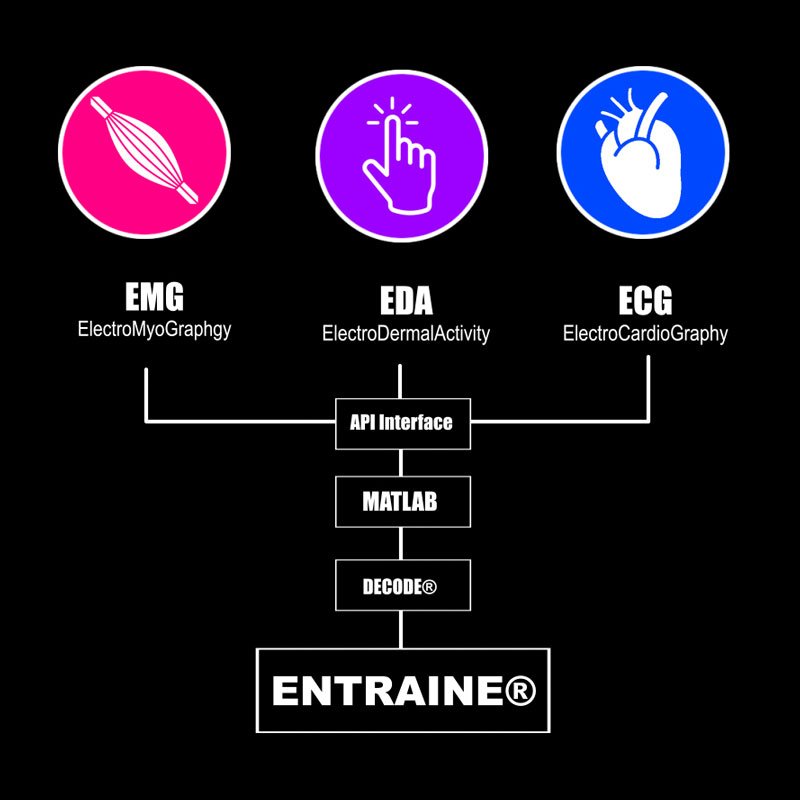
H-C-I incorporates and integrates EMG (ElectroMyoGraphgy), ECG (ElectroCardioGraphy) and EDA (ElectroDermalActivity) devices.
EMG, ECG and EDA sensor signals can be used for a variety of applications including interactive computer gaming and neurorehabilitation.
*H-C-I can integrate other device like EOC (ElectroOculoGraphy) and FEA (FacialExpresionAnalysis).
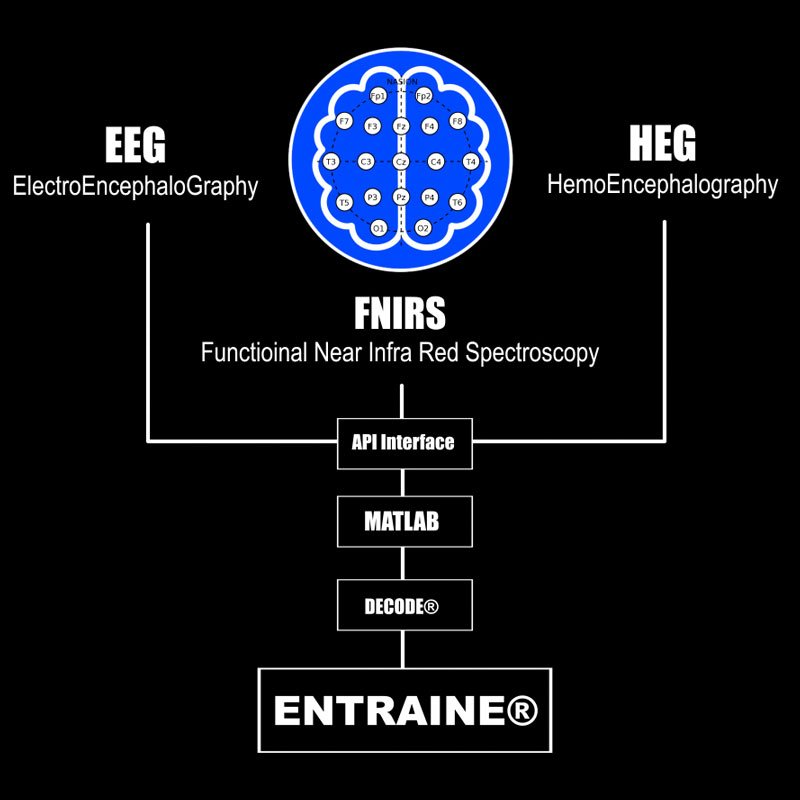
Brain-Computer Interface (B-C-I), sometimes called a Brain-Machine Interface (B-M-I), is a direct communication pathway between the brain’s electrical activity and an external device, most commonly a computer or robotic device.
B-C-I is often directed at researching, mapping, assisting, augmenting, or repairing human cognitive or sensory-motor functions.
They are often conceptualized as a human–machine interface that skips the intermediary component of the physical movement of body parts, although they also raise the possibility of the erasure of the discreteness of brain and machine.
B-C-I offer immense potential for neurorecovery and neurorehabilitation for patients with neurologic disease.
B-C-I may serve to measure and restore capacities lost due to neurologic injury or disease, or to induce plasticity to improve learning and remapping after neural injury.